
S-Corp vs LLC Taxes: What I Wish Someone Had Told Me Before I Filed
Advertisements
Here’s a stat that still blows my mind — roughly 70% of small business owners might be overpaying on taxes simply because they chose the wrong business structure. I was one of them! When I first started freelancing and eventually formed my own little company, nobody sat me down and explained the real difference between an S-Corp and an LLC when it comes to taxes.
And honestly, it cost me thousands. So let me break this down for you in a way that actually makes sense, because understanding S-Corp vs LLC taxes can literally save you a boatload of money.
First Things First: They’re Not Exactly Apples to Apples
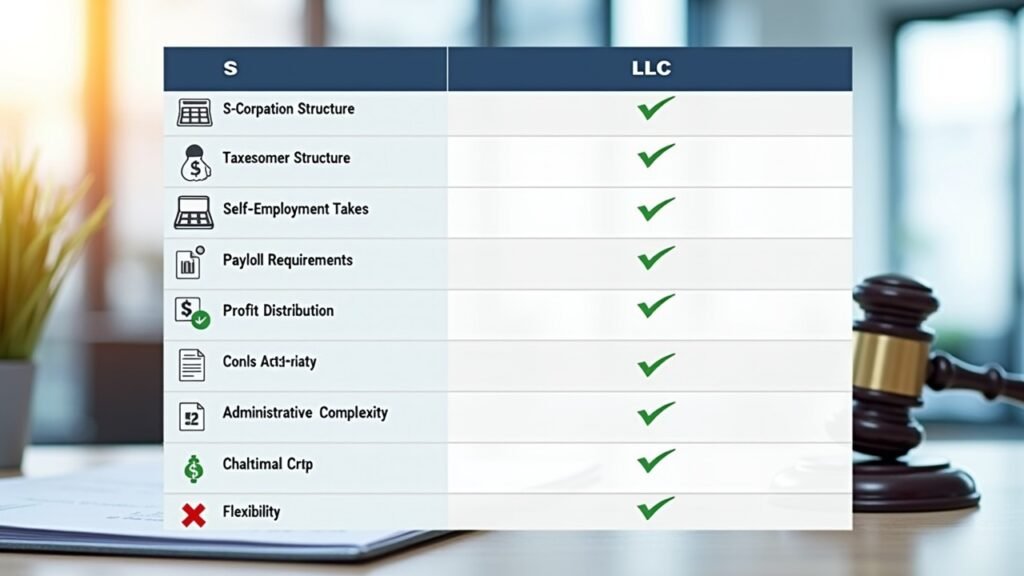
This is where I got tripped up early on. An LLC (Limited Liability Company) is a business structure, while an S-Corp (S-Corporation) is a tax classification. Wild, right? You can actually form an LLC and then elect to be taxed as an S-Corp with the IRS by filing Form 2553.
I remember sitting in my accountant’s office, totally confused, thinking these were two completely separate things. They’re not. Think of the LLC as the vehicle and the S-Corp election as choosing which engine goes inside it.
How LLC Taxes Actually Work
By default, a single-member LLC is treated as a “disregarded entity” for tax purposes. That means all your business income flows right through to your personal tax return on a Schedule C. Simple enough.
But here’s the kicker — you pay self-employment tax on all of your net profit. We’re talking 15.3% for Social Security and Medicare taxes on top of your regular income tax. When I had my first $80,000 profit year as a plain LLC, I nearly fell out of my chair when I saw the self-employment tax bill. It was brutal.
Multi-member LLCs get taxed as partnerships by default, but that self-employment tax issue? Still there for active members.
The S-Corp Tax Advantage (and Why Everyone Talks About It)
So here’s where things get interesting. When you elect S-Corp taxation, you pay yourself a “reasonable salary” and the remaining profit gets distributed to you without being subject to that 15.3% self-employment tax. It’s passed through as distributions instead.
Let me give you a quick example. Say your business nets $100,000 in profit:
Advertisements
- As a standard LLC: You’d owe roughly $14,130 in self-employment taxes on top of income tax.
- As an S-Corp: You pay yourself a reasonable salary of, say, $50,000 — you pay payroll taxes only on that $50,000. The other $50,000 comes to you as a distribution, free from self-employment tax.
That’s potentially saving you over $7,000 a year. I literally did a little dance when my CPA showed me this math for the first time.
But Wait — S-Corp Isn’t Always the Move

Here’s something people don’t talk about enough. The S-Corp election comes with extra costs and headaches. You gotta run payroll, which means payroll software or a service. There’s additional tax filings, specifically Form 1120-S. And if you mess up that “reasonable salary” thing, the IRS can reclassify your distributions as wages and hit you with penalties.
Generally speaking, most accountants say the S-Corp election starts making sense when your net business income is consistently above $40,000 to $50,000 per year. Below that, the extra administrative costs might eat up your savings. I made the mistake of electing S-Corp status too early and ended up paying more in accounting fees than I saved on taxes that first year.
Which One’s Right for You?
Honestly, it depends on your situation. Consider your annual profit, your state’s tax rules (some states like California charge an extra S-Corp fee), and how much administrative stuff you’re willing to deal with. Talk to a qualified CPA — not just your buddy who “knows taxes.”
The Bottom Line on Your Bottom Line
Choosing between S-Corp and LLC taxation isn’t a one-size-fits-all decision, and what works for your neighbor’s business might not work for yours. The important thing is that you’re even asking the question — that puts you ahead of most people. Do your homework, crunch those numbers, and don’t be afraid to revisit this choice as your business grows.
Want more straightforward breakdowns on small business taxes and deductions? Head over to Deduction Desk and poke around — we’ve got plenty of posts that can help you keep more of your hard-earned money where it belongs.