Advertisements

Understanding Tax Brackets 2025: What Nobody Told You (But Should Have)
Here’s a stat that blew my mind: according to the IRS, millions of Americans overpay their taxes every single year — not because they’re cheating, but because they simply don’t understand how tax brackets actually work. I was one of those people for way too long, and honestly? It cost me money I didn’t need to lose.
Understanding tax brackets in 2025 isn’t just “nice to know” information — it’s the kind of stuff that can literally change how much you keep in your pocket. So let’s break this down together, the way I wish someone had explained it to me years ago.
Wait… What Even Is a Tax Bracket?
Okay, real talk. For years, I thought being in a “higher tax bracket” meant ALL my income got taxed at that higher rate. Nope. That’s one of the most common tax misconceptions out there, and it tripped me up big time in my late 20s when I got a raise and panicked for absolutely no reason.
A tax bracket is basically a range of income that gets taxed at a specific rate. The U.S. uses a progressive tax system, which means only the portion of your income that falls within each bracket gets taxed at that bracket’s rate. Think of it like filling up buckets — each bucket has its own price, and you only pay that price for what goes into that specific bucket.
The 2025 Federal Income Tax Brackets Explained
The IRS adjusts tax brackets every year for inflation, and 2025 is no different. Here’s a quick breakdown of the 2025 federal income tax brackets for single filers:
- 10% — On income from $0 to $11,925
- 12% — On income from $11,926 to $48,475
- 22% — On income from $48,476 to $103,350
- 24% — On income from $103,351 to $197,300
- 32% — On income from $197,301 to $250,525
- 35% — On income from $250,526 to $626,350
- 37% — On income over $626,350
Married couples filing jointly have wider brackets — you can check the full breakdown over at NerdWallet for a side-by-side comparison. It’s actually really helpful to see it laid out that way.
A Real-Life Example (My Own Mess-Up)
Let me paint you a picture. Back when I was freelancing, I made about $55,000 in a year and assumed I owed 22% on all of it. I set aside way too much money, stressed through the whole spring, and filed my return holding my breath. Turns out, only the slice of income above $48,475 got taxed at 22%. Everything below that was taxed at lower rates.
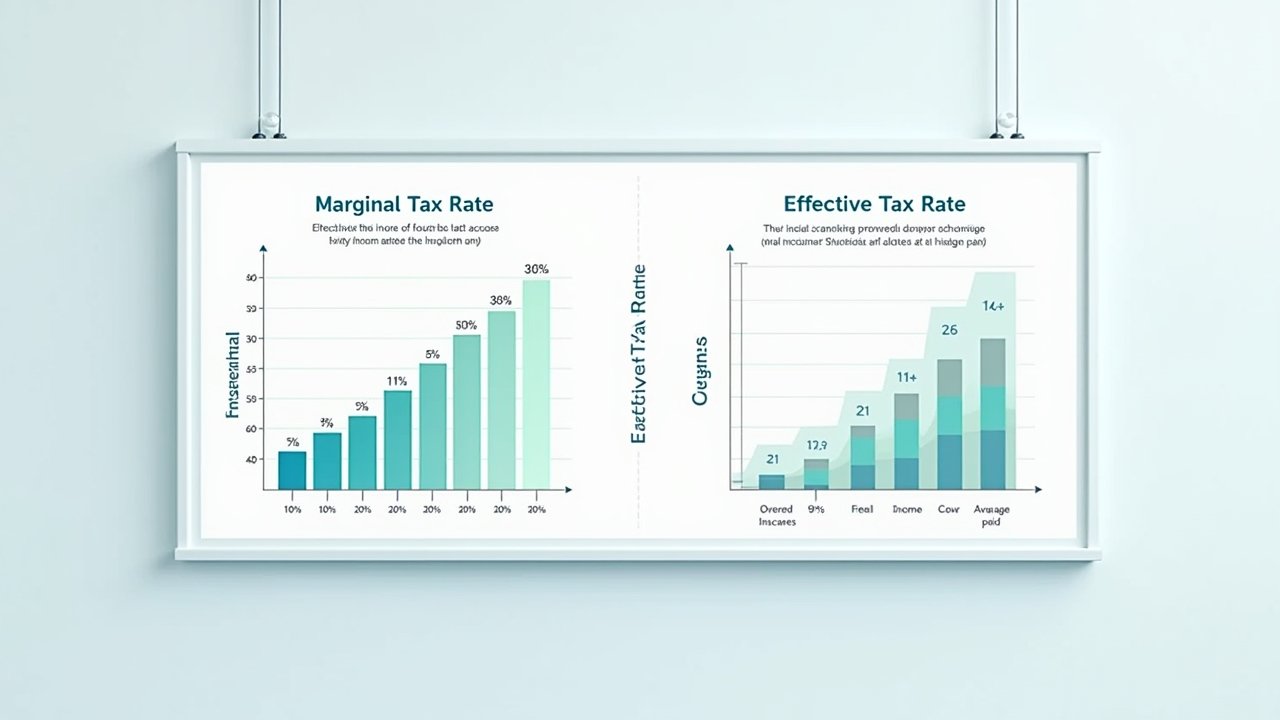
My effective tax rate — the actual average rate I paid — ended up being way lower than 22%. That’s the difference between your marginal tax rate (the rate on your last dollar earned) and your effective tax rate (what you actually pay on average). These two terms get mixed up constantly, even by people who should know better.
Advertisements
Practical Tips to Work With Your Tax Bracket
Alright, here’s where it gets genuinely useful. Knowing your bracket is one thing — using that knowledge is another. A few things that have helped me personally:
- Max out your 401(k) or IRA contributions. These reduce your taxable income, which can sometimes push you into a lower bracket. The 2025 401(k) contribution limit is $23,500 — worth every penny if you can swing it.
- Time your income smartly. If you’re self-employed or have control over when you receive income, sometimes pushing a payment to the next tax year makes sense.
- Use a tax calculator. Tools like the SmartAsset Tax Calculator make it super easy to estimate your liability without guessing.
Standard Deduction in 2025 — Don’t Skip This Part
One thing a lot of folks forget is that you don’t pay taxes on your gross income — you pay on your taxable income, which is your income after deductions. In 2025, the standard deduction is $15,000 for single filers and $30,000 for married couples filing jointly. That’s a significant chunk that gets knocked off before a single bracket even applies to you.
So yeah, if you’re a single filer making $50,000, you’re not starting at $50,000 in the brackets — you’re starting at $35,000 after the standard deduction. Big difference, right?
Your Taxes Don’t Have to Be a Mystery Anymore
Look, taxes will probably never be anyone’s favorite topic — trust me, I get it. But once you actually understand how tax brackets work in 2025, the whole process feels a lot less scary and a lot more manageable. Knowledge really is power here, and the peace of mind that comes from understanding your own financial picture? Priceless.
Everyone’s situation is different, so take this info and make it your own. Consider your filing status, your deductions, and your income sources — and when in doubt, always consult a qualified tax professional for personalized advice. Don’t just wing it the way I did early on!
If you found this helpful, there’s a whole lot more where that came from. Head over to Deduction Desk and explore other posts that break down the confusing world of taxes into plain, everyday language. You’ve got this!