
Tax Benefits of Marriage: What I Wish Someone Had Told Me Before I Filed
Advertisements
Here’s a wild stat that still blows my mind — married couples filing jointly can save anywhere from a few hundred to tens of thousands of dollars a year compared to filing as single. When my wife and I got hitched back in 2016, taxes were honestly the last thing on our minds. Big mistake.
I mean, nobody walks down the aisle thinking about standard deductions, right? But the tax benefits of marriage are genuinely one of the best financial perks of tying the knot. And I really wish I’d understood them sooner instead of fumbling through our first joint return like a deer in headlights.
Filing Jointly vs. Filing Separately — The Big Decision
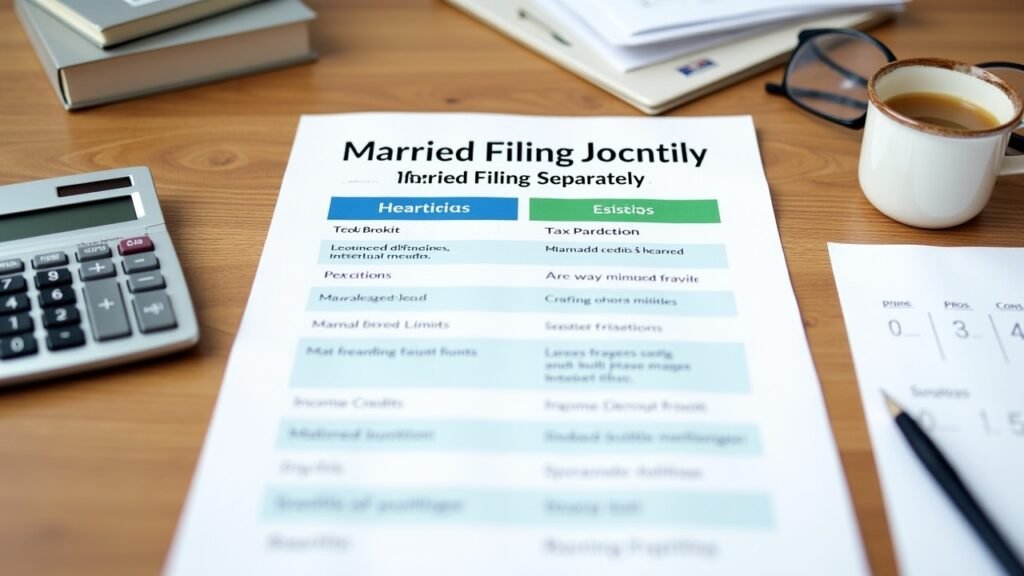
Okay so the first thing you gotta know is that married couples get two filing options: married filing jointly or married filing separately. For most people, filing jointly is the way to go because the tax brackets are significantly wider.
What does that mean in plain English? Basically, more of your combined income gets taxed at lower rates. For 2026, the IRS standard deduction for married couples filing jointly is nearly double what single filers get — we’re talking around $30,000 versus roughly $15,000.
I remember our first year filing together, I almost checked “married filing separately” because I thought it would be simpler. My accountant practically slapped my hand and said, “Don’t you dare.” That one conversation saved us over $3,000. Lesson learned.
The Marriage Tax Bonus Is Real
You’ve probably heard people complain about the so-called “marriage penalty.” And yeah, it exists — but mostly for couples where both spouses earn similar high incomes. For the rest of us, there’s actually a marriage tax bonus.
This bonus kicks in when one spouse earns significantly more than the other. The higher earner’s income effectively gets pulled down into lower tax brackets because it’s combined with the lower earner’s income on a joint return. When my wife took two years off after our daughter was born, our tax bill dropped noticeably.
According to the Tax Policy Center, roughly 60% of married couples receive a tax bonus from filing jointly. Those are pretty good odds if you ask me!
Deductions and Credits You Unlock Together
Beyond the bigger standard deduction, marriage opens up a bunch of other tax advantages that people overlook. Here are some of my favorites:
Advertisements
- Earned Income Tax Credit (EITC): The income thresholds are higher for married couples, so you might qualify even if you wouldn’t as a single filer.
- IRA contributions for a non-working spouse: This one’s huge. Even if your spouse doesn’t earn income, you can contribute to a spousal IRA and get the tax deduction.
- Gift and estate tax exemptions: Married couples can transfer unlimited assets to each other tax-free. Unlimited! That’s called the unlimited marital deduction and it’s a big deal for estate planning.
- Capital gains exclusion on home sales: Single filers can exclude $250,000 in gains. Married couples? A whopping $500,000.
I didn’t know about the spousal IRA thing until year three of our marriage. We’d been leaving free tax-advantaged retirement savings on the table the whole time. It still kind of bugs me honestly.
Health Insurance and Other Overlooked Perks

One thing that doesn’t get talked about enough is how marriage affects your health insurance costs from a tax perspective. If one spouse has employer-sponsored coverage, adding the other spouse is often cheaper than two individual plans — and those premiums can sometimes be paid with pre-tax dollars.
Also, if you’re itemizing deductions, combining medical expenses on a joint return can help you hit that 7.5% AGI threshold faster. My buddy Jake and his wife saved a decent chunk one year just by combining their medical bills on their joint filing. It’s the kind of thing that sounds boring until you see real dollars coming back to you.
Before You Walk Away — A Few Things to Keep in Mind
Look, the tax benefits of marriage are legit, but everyone’s situation is different. If both spouses are high earners, you might actually face a marriage penalty. It’s worth running the numbers both ways or chatting with a tax professional before making assumptions.
My biggest piece of advice? Don’t leave money on the table like I did those first couple years. Educate yourself, ask questions, and revisit your tax strategy every single year because life changes fast.
If you found this helpful, there’s a lot more where this came from — head over to Deduction Desk and browse our other posts on tax strategies, deductions, and smart money moves. Your future self will thank you.